By Robert Duckworth
Former FINRA-Licensed Securities Representative (1997-2009)
In Service Of You
I spent 12 years as a licensed securities professional. Even though I'm no longer licensed, I still hold myself to fiduciary standards. That means:
- Complete transparency (see every trade I made)
- Honest disclaimers (past performance doesn't guarantee future results)
- Fair pricing (these books cost less than one hour with an advisor)
- No recommendations (positions shown are meant to be examples only)
- No pressure tactics (decide if this is right for you)
I'm not trying to sell you something you don't need. I'm showing you a system that worked for multiple positions and explaining how to use it yourself. The choice is always yours.
The Lesson That Changed Everything
Early in my 12-year career as a financial advisor, I made a mistake that shaped everything I'd build later.
A well-respected technical analyst—someone who appeared on CNBC regularly—convinced me to sell half of a position that had been performing exceptionally well for my clients. His analysis was detailed. His reasoning seemed sound. And I was only two years into the industry, so I trusted the expert.
That position went on to become one of the best performers of that era. Those clients left money on the table.
That taught me something fundamental: Predictions fail, even from the most credible sources. Math doesn't.
The Foundation: Over 10 Years Managing Real Money
From 1997 to 2009, I worked as a Series 7, 52, 63, and 65 FINRA-licensed securities registered representative managing client portfolios through the dot-com crash, the housing bubble, and the 2008 financial crisis.
In an industry where most brokers sold pre-packaged products, I built custom municipal bond ladders for clients. As a Series 52 Municipal Representative (one of the rarest licenses in the industry), I understood fixed income at a level most retail investors never learn.
This is why I don't recommend bond ETFs/UITs in the ISM framework. I want to know exactly how much you'll receive and when. A properly laddered bond portfolio provides predictable income and defined maturity dates—something an ETF can never deliver.
For younger investors or those with smaller portfolios, bond ETFs are acceptable as a diversification tool. But if you're building serious wealth, you need to understand true fixed income allocation.
My approach—which I documented years later in my 2015 book Investing Made Easy: Introduction to Institutional Style Management—focused on disciplined asset allocation and systematic rebalancing. Set target allocations. Monitor positions. Rebalance when they drifted too far from the target.
It worked. But traditional rebalancing was slow. You'd watch a position drift 10-20% from its target allocation and wait weeks or months for the right moment to act. Trading costs, whole-share requirements, and execution delays made frequent adjustments impractical.
So you rebalanced quarterly. Maybe only annually. You captured some of the volatility advantage, but you left a lot on the table.
2020: The Realization
In 2020, someone asked for help with their portfolio. As I set up their allocations using my Investing Made Easy: Introduction to Institutional Style Management framework, I noticed something had fundamentally changed since I'd left the industry.
Fractional shares. Zero-commission trading. Real-time portfolio tracking. Even a 2% swing on a larger, more volatile stock could make a noticeable difference in a portfolio.
The friction that made traditional rebalancing slow had disappeared.
Volatility swings that used to require waiting for quarterly rebalancing could now be captured continuously. Instead of rebalancing four times a year, you could rebalance four times a day if the math called for it—at zero cost.
I grabbed an envelope and sketched out the mechanics: Fixed Target Allocations for each position. Deviation triggers (strike zones) that automatically signal when to buy or sell. Pure mathematical responses to price movement—no predictions about market direction required.
A couple of days later, I had the system mapped out completely.
Then I needed to prove it worked.
The Test: 2020-2023
From October 2020 through July 2023, I ran this system in a live brokerage account using real capital. Not simulations. Not backtests. Real trades executed through real market conditions:
-
March 2020: COVID crash (-34% in 23 days)
-
2021: Bull market pushing to all-time highs
-
2022: Bear market with a -25% drawdown
-
2023: Recovery and new highs
Every single trade was documented with brokerage confirmations. Every buy. Every sell. Every cost-basis adjustment.
The results:
QQQ (Nasdaq-100 ETF):
- MicroRebalancing final value: $36,127
- Buy-and-hold final value: $14,738
-
Difference: $21,389 more (+145% better performance)
- Plus over 400 shares retained for continued growth
SPY (S&P 500 ETF):
- MicroRebalancing final value: $42,233
- Buy-and-hold final value: $27,703
-
Difference: $14,530 more (+52% better performance)
- Plus over $152,000 position retained
All documented. All verifiable. Complete trade logs, cost-basis spreadsheets, daily portfolio snapshots—everything is available on the proof page.
This wasn't luck. It was mechanical precision, capturing volatility that buy-and-hold investors simply endure.
Why MicroRebalancing Exists
After 12 years in the financial services industry, I saw the pattern clearly: Advisors collect fees whether portfolios go up or down. Clients are told to "stay invested" through 30-50% drawdowns and wait for eventual recovery. The industry has no real answer for volatility except "ignore it."
But volatility isn't the enemy. It's an opportunity—if you have a mechanical system to capture it.
MicroRebalancing exists because the market structure has finally evolved to make something better possible. Technology removed the friction. Fractional shares and zero commissions made continuous rebalancing practical. And the math—once you see it—is undeniable.
This isn't a subscription service. It's not asset management with ongoing fees. It's not a prediction system that requires you to time the market or trust expert forecasts.
It's an educational framework you can implement yourself. A mechanical system tested with real money and documented with real trades. The kind of approach I wish had existed when I started managing client portfolios in 1997.
The math either works or it doesn't. The proof is public.
Our Youth Are The Future
The biggest mistake in financial education is ignoring young people when they have the most to gain. A 25-year-old with $5,000 and the right system can build more wealth than a 45-year-old with $100,000 and a poor strategy.
I spent years in the securities industry watching advisors ignore clients with 'small' portfolios. But $1,000 at age 20 could be worth more than $100,000 at age 40—if you know what to do with it.
Nobody teaches systematic investing to young people. They're pulled away chasing after fancy option strategies and guessing the next meme coin. Even conservative advice like, 'just buy index funds and hold' leaves them helpless during crashes and clueless about portfolio management.
This system changes that. It works with $100 or $1,000,000. It works whether you're 18 or 78. But the earlier you start, the more powerful it becomes.
If you're young and nobody's taken you seriously as an investor yet, I'm taking you seriously. Learn the system. You can gather much of it for free by poking around the site. Start small. Build wealth.
Three Ways to Get Started
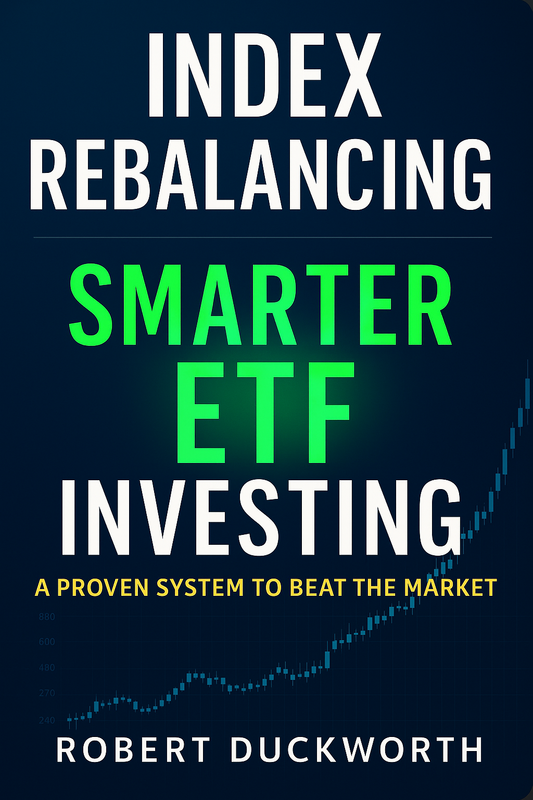
Index Rebalancing: The Smarter Way to Invest in ETFs - $10 $5
Entry-level guide focused on managing core ETF positions like SPY and QQQ using simplified rebalancing principles. Perfect if you're new to systematic investing and want to start with lower complexity.
MicroRebalancing: The Art of the Micro-Rebalance - Standard Edition - $15
The complete 270+ page system with detailed mechanics, real trade examples, optimization techniques, and advanced strategies. Everything you need to implement the full methodology.
MicroRebalancing VIP Toolkit - $37
Complete package: All three books (ISM + IR + MR Standard) plus professional spreadsheet tools, video training, cash reserve strategies, and lifetime updates. One-time payment. No subscriptions.
Choose your starting point →
Questions? Read the FAQ or contact us.
Want to see the proof first? View complete trade documentation →